Four electric drivetrains, and what each would mean for a classic coach.
A slide-by-slide walkthrough of Allison, BYD, Eaton and Edison Motors: how each works, pros and cons, maintenance, installation in a 40-ft diesel pusher, house power, and cost of ownership. Compiled October 23, 2026 from public sources. Listed for reference only; we have no partnership with these companies.
Maker claim what the manufacturer says
Independent government test, public record or trade press
Estimate typical engineering range, not a measured figure
Can truck and bus electric hardware power a 40-ft diesel pusher?
Our reference coach is a 2002 Country Coach Magna: 40 ft with a tag axle, a rear Cat C12 diesel (about 425–505 hp and up to about 1,550 lb-ft) and an Allison MH 4000 six-speed automatic. Coaches like it weigh as much as a loaded truck and need house power too.
Four makers
Allison (hybrid unit and e-axles), BYD (complete electric buses and trucks), Eaton (EV transmissions and power electronics) and Edison Motors (diesel-electric series hybrids).
Four questions each
How it works · pros, cons and cost of ownership · maintenance and installation in a coach · whether it can run the 12 V house side and 120/240 V loads.
The bottom line
None sells a bolt-in motorhome kit. A parallel add-on that keeps the C12 and MH 4000 is the near-term path; a full series hybrid is a larger engineering build. Details on the last slides.
Use the arrows, your keyboard’s ← → keys, or swipe.
Background
Four ways to put electric drive in a heavy vehicle
1 · Parallel add-on keeps engine + transmission
An electric motor helps the diesel through the transmission (for example on its power take-off, PTO). Smallest change; no engine-off driving in PTO systems like Odyne’s.
2 · Hybrid transmission Allison eGen Flex
Motors replace the automatic transmission and share work with the engine. Sold for transit buses.
3 · Central motor + gearbox Eaton 4-speed
Engine and transmission come out; a motor and multi-speed EV gearbox drive the existing driveshaft and axle.
4 · E-axle, battery-electric or series hybrid Allison eGen Power · BYD · Edison
Motors live in or on the axle. With a diesel genset added it becomes a series hybrid (Edison), the concept described on this page.
Allison Transmission · 1 of 4 · How it works
Two different products: eGen Flex and eGen Power
eGen Flex is a two-motor hybrid unit that takes the place of a transit bus’s automatic transmission. The diesel and the motors share the work, braking energy goes into an Allison-supplied 26 kWh lithium-titanate pack (450–756 V), and the bus can run engine-off in mapped zones. Ratings: 280 hp / 910 lb-ft or 330 hp / 1,050 lb-ft input.
eGen Power is a complete electric rear axle with motor(s), a 2-speed gearbox and the differential in one housing, for battery-electric trucks and buses.
eGen Power
Continuous / peak
Wheel torque
Axle rating
85S
225 / 325 kW
12,000 N·m
18,739 lb
100S · 130S
225 / 325 kW
26,000 N·m
23,000–28,660 lb
100D · 130D
450 / 650 kW
47,000 N·m
23,000–28,660 lb
Recommended battery voltage 550–850 V. Maker claim 100% regenerative braking torque capability.
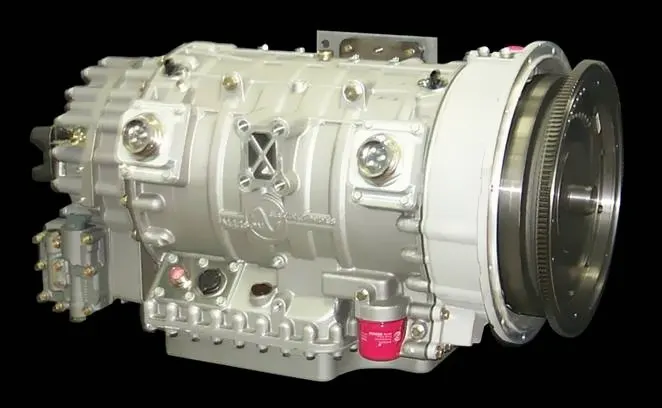
Allison EP 50, the earlier hybrid unit that eGen Flex succeeds. Photo: Resaleking, Wikimedia Commons, public domain.
Proven brand, but sold only to bus and truck makers
Advantages
Maker claim eGen Flex: up to 25% better fuel economy and up to 50% engine-off operation (duty-cycle dependent).
Independent NREL’s King County Metro study of the earlier Allison hybrid: 27% better fuel economy and 15% lower total operating cost per mile than diesel.
eGen Power packs motors, gearbox and differential into one axle; Allison’s existing distributor and service network.
Disadvantages
eGen Flex is rated to 1,050 lb-ft, well below a C12’s ~1,550 lb-ft, and is offered only through transit-bus builders.
Independent IndyGo’s eGen Flex buses ran engine-off 19–40% of the time, below the 50% claim.
eGen Power needs a full high-voltage battery-electric (or series-hybrid) design; an eGen Power axle weighs about 929 kg (2,048 lb).
Feasibility for a Magna-type coach: low. Nothing from Allison replaces an MH 4000 in a motorhome. eGen Power could only serve as the drive axle in a ground-up electric or series-hybrid rebuild, and Allison sells to vehicle manufacturers.
Cost of ownership:Independent DeKalb, Illinois approved $972,239 for a 35-ft hybrid bus against $606,629 for diesel (about $366K more). NREL found maintenance roughly even with diesel on the older system. eGen Power price Not public.
Battery & supplier: eGen Flex: 26 kWh lithium-titanate, supplied by Allison (cell maker Not public). eGen Power: no battery from Allison; the vehicle builder chooses one, e.g. Anadolu Isuzu’s Novo Volt bus pairs an 85S with 176 kWh LFP.
Allison Transmission · 3 of 4 · Maintenance & installation
Low routine service, recent software campaigns, big install
Maintenance
Maker claim eGen Power is filled for life with no oil changes; Allison says it will validate that over the next 5–10 years. TES 668 synthetic fluid, integrated oil cooler and pump.
Field action 2025FA13 (Dec 2, 2025, MY2024–25 eGen Flex buses): software to stop drive-unit oil expulsion through the breather (oil level recalibrated about 1.66 L lower), added cooling-fault protection for the inverter, DC-DC converter and battery, and fixes for false battery-relay fault codes.
2025FA15: software update for eGen Power on refuse-truck units.
Service through Allison’s distributor network; anyone opening the 450–850 V system needs high-voltage safety training.
Installation in a 40-ft pusher
Space: eGen Power replaces the rear drive axle; engine, MH 4000 and driveshaft come out; the pack goes in the engine bay and basement bays.
Weight: eGen Power axle about 929 kg (2,048 lb). Pack weight depends on size: Estimate about 20 lb per kWh installed, from BYD’s published 8TT curb weights (422 vs 563 kWh: +2,873 lb).
Electrical: 550–850 V pack, inverters, HV DC-DC for 12/24 V, cooling loops, charging inlet.
Labor:Not public. A one-off engineering program with brake, axle-rating and weight review, not a shop bolt-in.
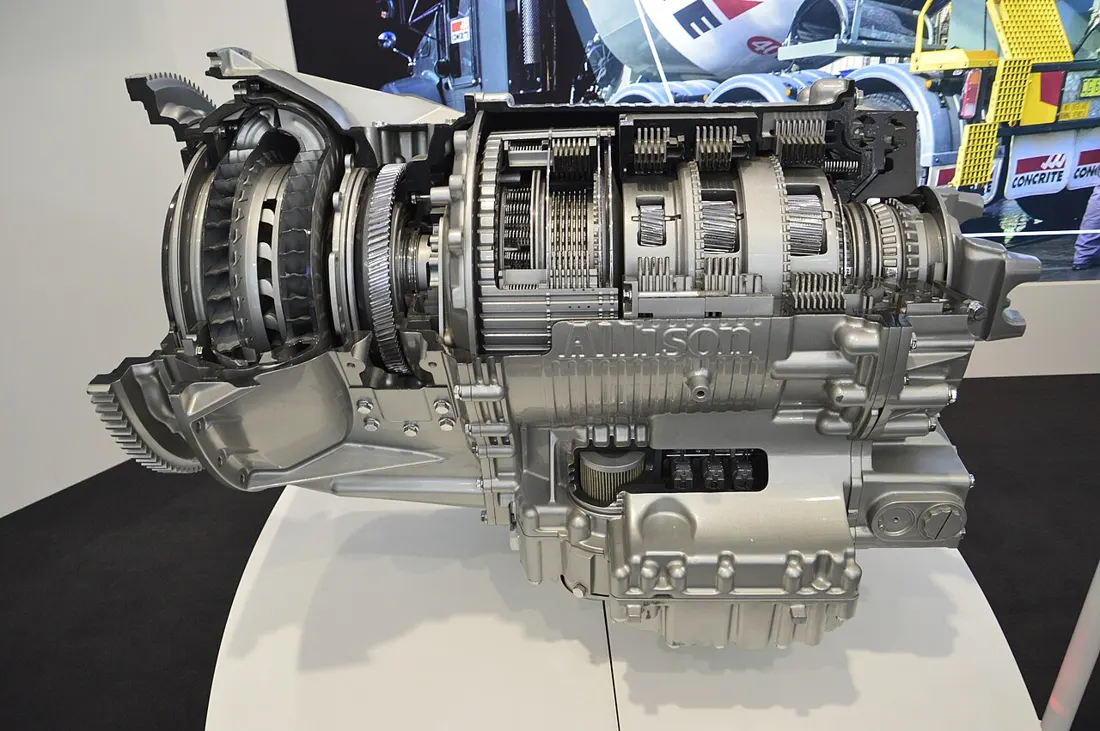
Allison 4000 Series six-speed, the transmission family in many diesel pushers (the Magna has an MH 4000). Photo: Spielvogel, Wikimedia Commons, CC BY-SA 4.0.
Allison Transmission · 4 of 4 · 12 V house power & coach batteries
eGen Flex buses already make 24 V from the hybrid pack
12/24 V from high voltage
eGen Flex systems use a Vanner Hybrid Beltless Alternator, a DC-DC converter that replaces the belt alternator: 500–780 V in, 28 V out, 300 A per unit (about 8.4 kW), 600 A dual. It is 24 V; a 12 V coach would need a 12 V-output converter or a 24→12 V stage. eGen Power: no DC-DC from Allison; the builder supplies it.
Traction pack as house bank?
Not something Allison offers. The 26 kWh LTO pack is sized for hybrid power bursts, not overnight camping, and it is a 450–756 V system. A coach should keep a separate 12/24 V battery for starting, controls and contactors. Using a larger eGen Power-style pack for house loads would be the builder’s design (see BYD/Edison slides for pros and cons).
AC power & inverters
Vanner’s IAP2 package for eGen Flex includes an inverter (VEPI) that turns 600 V DC into 230 V three-phase for electric A/C and air compressors. A coach needs 120/240 V split-phase, so a different inverter would be required. Estimate typical coach peaks: 3 roof A/Cs at ~1.2–1.8 kW each running, plus induction at 1.8–3.7 kW, point to a 6–10 kW inverter.
Whole electric vehicles, battery to wheels, all BYD
BYD builds complete battery-electric buses and trucks, including its own lithium iron phosphate (LFP) cells and packs, motors and controls. North American models are assembled in Lancaster, California, now under the RIDE brand. There is no engine, so range depends entirely on charging.
K-series transit buses: a motor and reduction gear at each rear drive wheel. Axle options 2 × 90 kW, 2 × 150 kW or 2 × 180 kW (2 × 1,500 N·m). Packs roughly 100–600 kWh depending on length.
8TT Class 8 tractor: 422 kWh (150+ mi) or 563 kWh (200+ mi) LFP, DC charging 130–230 kW, 82,000 lb GCWR. Curb weight 26,040 / 28,913 lb.
BYD markets its newer LFP cells as “Blade” batteries.
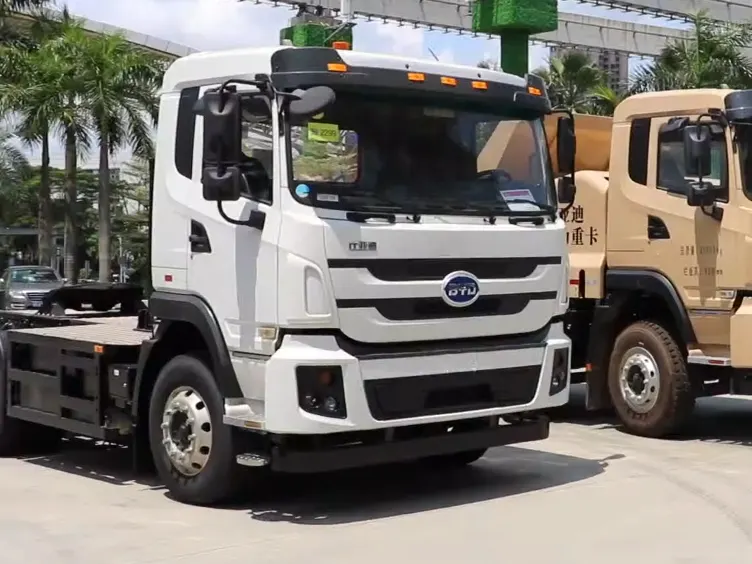
BYD 8TT electric tractor in Shenzhen. Image: Vincent Everts, Wikimedia Commons, CC BY 3.0.
Huge battery maker, mixed early US record, no retrofit parts
Advantages
Vertically integrated: BYD designs its own cells, packs and motors, and is one of the world’s largest battery makers.
Independent A California Energy Commission study of LADOT’s BYD buses found operating costs about one-third of CNG buses.
LFP chemistry: long cycle life and good thermal stability.
Disadvantages
Independent LA Metro suspended its BYD bus demonstration in 2016 over range, hill climbing and reliability; Albuquerque rejected its BYD buses in 2018 (177 mi vs 275 promised, brake, door and battery-case issues).
No engine: range is bounded by the pack; a coach would need hundreds of kWh.
Parts, software and service are tied to one company.
Feasibility for a Magna-type coach: very low. We found no evidence BYD sells its axles, motors or packs to retrofitters in the US. It is useful as a benchmark for pack size and weight.
Cost of ownership:Independent the LADOT buses cost $778,000 each; the study estimated about a 10-year payback. 8TT price Not public; California HVIP vouchers are $120,000 ($150,000 for drayage).
Battery & supplier: BYD’s own LFP (Blade on newer models): 422 or 563 kWh in the 8TT; about 100–600 kWh in K-series buses.
Big LFP packs could run a coach, but BYD doesn’t sell them for it
12/24 V from high voltage
Like other battery-electric vehicles, BYD’s make low-voltage power with an onboard DC-DC converter instead of an alternator; ratings Not public. Off-the-shelf converters exist from others (Eaton: 3–5 kW at 12 V, 5–10 kW at 24 V).
Traction pack as house bank?
LFP tolerates deep, daily cycling better than most chemistries, which is why a shared pack is attractive. The cons: every kWh used camping is range lost; the HV pack must be awake (contactors closed, BMS running) to feed loads, which adds standby draw; and the coach still needs an isolated 12 V battery for starting and safety systems. Estimate a 3-day boondock at 10–15 kWh/day uses 30–45 kWh.
AC power & inverters
No BYD 120/240 V export product found for North America Not public. A coach build would need an HV-input or low-voltage inverter of roughly 6–10 kW Estimate, plus shore power routed to the HV charger.
Sources: Eaton HV DC/DC data sheet · consumption ranges are typical engineering values, not BYD data.
Eaton · 1 of 4 · How it works
A 4-speed EV gearbox that lets a smaller motor move a heavy load
Eaton makes components, not complete systems. Its heavy-duty 4-speed EV transmission sits behind one central electric motor, roughly where the engine and transmission were, and keeps the driveshaft and rear axle. A deep first gear helps a smaller motor launch and climb.
Max input torque
2,600 N·m (about 1,920 lb-ft)
Max input speed
5,000 rpm
Ratios
5.88 · 3.30 · 1.82 · 1.00
Dry weight
192 kg (423 lb), 650 mm long
Oil
7 L, cooler-less operation
PTO
Rear PTO, up to 700 N·m continuous
Controls
12 or 24 V control module
The Eaton Cummins joint venture builds the Endurant automated transmissions for diesel trucks. Eaton sold a parallel diesel-electric hybrid for medium-duty trucks until 2014.
Original diagram based on Eaton’s published specifications. No openly licensed photo of the EV transmission was available.
The most retrofit-shaped part, if you build the rest yourself
Advantages
Keeps the coach’s driveshaft and rear axle; a central motor + 4-speed takes the place of the C12 and MH 4000.
Maker claim extends range or allows a smaller battery, and improves grade climbing with a smaller motor.
Light (423 lb) with a PTO for accessories; Eaton also sells HV DC-DC converters.
Disadvantages
Motor, inverter, battery, controls and integration all come from others.
2,600 N·m input limit: the motor must be matched to a 40,000+ lb coach.
Eaton left the North American hybrid market in 2014, citing weak demand. Heavy-duty 4-speed is new (launched in 2024); maintenance intervals still listed as “TBD”.
Feasibility for a Magna-type coach: possible as a component in a central-motor or series-hybrid design. Small-volume sales to converters Not public.
Cost of ownership: price Not public. Independent NREL’s 36-month study of UPS vans with Eaton’s earlier hybrid found 23% better fuel economy and 19% lower fuel cost per mile, but 96.3% uptime against 99.0% for diesel.
Battery & supplier: Eaton supplies no traction battery. Example pairing: Proterra ZX5 buses used Eaton’s transmission with 450–675 kWh Proterra packs.
Simple gearbox service; the integration is the hard part
Maintenance
7 L of oil, no external cooler or lubrication system required; maintenance intervals “TBD” on Eaton’s spec sheet.
Diagnostics through Eaton ServiceRanger; Eaton’s established transmission service network, though EV-specific service coverage is Not public.
Recalls or field actions for the HD 4-speed: none found in our search.
The motor, inverter and battery carry their own makers’ service and HV training requirements.
Installation in a 40-ft pusher
Space: motor + gearbox in the rear engine bay where the C12 and MH 4000 sit; pack in basement bays and the freed engine space.
Weight: gearbox 423 lb; motor and inverter depend on supplier Not public; battery about 20 lb/kWh Estimate. Removing the C12, MH 4000, fuel and cooling offsets part of this.
Electrical: transmission control module runs on 12 or 24 V. HV voltage set by the chosen motor and pack.
Labor:Not public; custom adapter, mounts, driveshaft length and controls work.
Eaton · 4 of 4 · 12 V house power & coach batteries
Eaton sells the converter that makes 12 V from an EV pack
12/24 V from high voltage
Eaton’s HV DC/DC family replaces the alternator: 800 V → 14 V at 3 or 5 kW (214–357 A), 800 V → 28 V at 5 or 10 kW, 400 V → 14 V at 3 kW. Liquid-cooled, up to 95% efficient; input 500–850 V for the 800 V models. Bi-directional versions are optional.
Traction pack as house bank?
Possible in a central-motor build, because the builder picks the pack. Keep a separate isolated 12 V battery for starting, BMS and contactors; size the pack so camping use doesn’t cut into the reserve needed to drive. Estimate a 5 kW 12 V converter covers chassis loads plus a large 12 V house panel.
AC power & inverters
Eaton’s transmission doesn’t export AC. The rear PTO (700 N·m) could drive an accessory generator, but a separate 120/240 V split-phase inverter is the cleaner route. Estimate 6–10 kW for roof A/Cs plus induction; shore power would charge the pack through an onboard charger.
A diesel that only makes electricity: the same idea as our coach
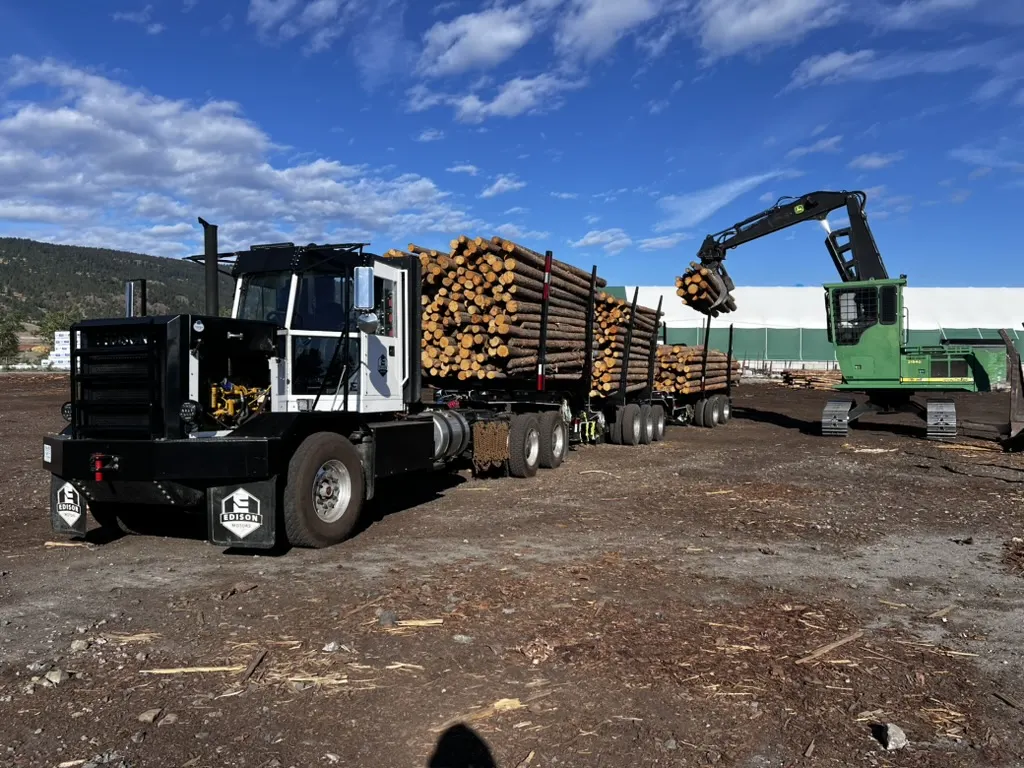
Edison Motors (Golden, British Columbia) builds diesel-electric series hybrids. Electric axles drive the wheels, an LFP battery buffers energy, and a diesel engine runs only as a generator. The trucks can plug in to charge, and the generator is always there as a range backstop.
Series hybrid: no range anxiety, regenerative braking, high torque, quiet running when the genset is off.
Mostly off-the-shelf parts, and customers get a bill of materials with supplier details to source replacements.
Maker claim about 30% fuel savings for the pickup kit; larger savings in stop-and-go work.
Disadvantages
Early-stage company. Its own memorandum says the Class 8 hybrid stays in prototype and field validation, with production timing that “cannot presently be predicted.”
Pickup kit: Edison says it is “not legally certain” it can sell a retrofit and may offer a rolling chassis instead; the reservation page estimates 2027 delivery.
No coach kit, and independent fuel or reliability data Not public.
Feasibility for a Magna-type coach: good concept fit, low availability today. The pickup kit is too small for a 40-ft pusher; semi-scale components sold separately Not public. Best treated as a design reference and a consulting partner.
Cost of ownership: a customer prototype truck priced at $750,000 before rebates ($450,000 after), per Edison’s memorandum. Pickup kit “ideally” ⅓–½ the price of a new pickup; $250 non-refundable reservations. Kit price Not public.
Battery & supplier: LFP packs integrated by Edison (120 kWh Class 8 target; 60–65 kWh pickup). Cell and pack supplier Not public.
Edison Motors · 3 of 4 · Maintenance & installation
Designed for mechanics, still building its service network
Maintenance
Edison stresses serviceability: mostly off-the-shelf components and a parts list with suppliers for each truck.
Still two engines’ worth of systems: a diesel genset (oil, filters, emissions) plus the HV battery, inverters and oil-cooled e-axles.
Installer network: about 182 partner shops signed up (closed to new partners in 2024) for future kit installation and servicing. Recalls: none found; not yet in series production.
Battery thermal management and HV training needed, as with any 600 V system.
Installation in a 40-ft pusher
Space: the C12 and MH 4000 come out; a smaller genset goes in the engine bay; pack in basement bays; e-axle replaces the drive axle (tag axle stays).
Weight:Not public for Edison parts. Pack about 20 lb/kWh Estimate, so a 120 kWh pack ≈ 2,400 lb.
Electrical: 600 V system (pickup kit), CCS1 charging, DC-DC to the 12 V side.
Labor:Not public. Edison’s semis are built new; coach conversion would be custom engineering.
Edison Motors · 4 of 4 · 12 V house power & coach batteries
A shared pack plus a genset is the natural fit for a coach
12/24 V from high voltage
Edison’s Topsy walkthrough video describes DC-DC converters in the power distribution unit feeding the 12 V system; ratings Not public. Catalog converters like Eaton’s 3–5 kW 12 V units fit a 600 V system.
Traction pack as house bank?
This is the design described on this page: one LFP pack for driving and living, recharged by genset, solar and shore power. Pros: the separate house generator goes away and camping is silent. Cons: house use cuts driving reserve, the HV pack must stay awake to supply loads, and a small isolated 12 V battery is still required. LFP handles daily cycling well.
AC power & inverters
Edison’s memorandum lists prototypes with electric power-take-off configurations; AC export ratings Not public. For a coach, Estimate a 6–10 kW 120/240 V split-phase inverter, plus a shore-power charger into the pack.
*Odyne figure from our discussions with Odyne engineering, October 2026. Odyne’s PTO system gives launch assist and regeneration but no electric-only driving.
Summary · What it means
Two realistic paths for a classic diesel pusher
Near term: keep the C12 and MH 4000
A parallel add-on that drives through the Allison’s PTO (for example Odyne) adds launch assist, regenerative braking and 6 or 12 kW of 120/240 V engine-off power, without touching the engine, transmission or axles. It doesn’t give electric-only driving.
Long term: full series hybrid
Remove the engine and transmission and assemble a series hybrid from truck parts: e-axles (an eGen Power-class axle) or a central motor with a gearbox like Eaton’s, a 550–850 V LFP pack shared with the house, HV DC-DC converters for 12/24 V, a split-phase inverter, and a small genset, the approach Edison Motors uses. Allison and BYD generally don’t sell to small converters; Edison is the closest partner in concept.
Either way, every coach needs an individual weight, axle-rating and brake review first.
Notes & credits
How we compiled this
Public manufacturer documents, government studies, transit-agency records and trade press, current as of October 23, 2026. Each slide lists its sources.
“Maker claim” figures are the manufacturer’s; “Independent” figures come from third parties; “Estimate” marks typical engineering ranges we use for planning, not measured coach data.
Typical coach loads used for estimates: roof A/C (13,500–15,000 BTU) about 1.2–1.8 kW running each; induction cooktop 1.8–3.7 kW; residential fridge about 0.1–0.2 kW average.
Brand names identify products only; no affiliation or endorsement is implied. Specifications change; confirm with each maker.